how to start a digital product business Starting a digital product business sounds simple on paper: create something useful, put it online, and wait for people to buy it.
The reality is a little different.
The hardest part usually isn’t making the product. It’s choosing something people actually need, explaining its value clearly, getting your first few customers, and improving the product based on real feedback how to start a digital product business.
I’ve found that digital products work best when they solve a small, specific problem. A useful spreadsheet can sometimes sell better than a huge course. A well-made template can save someone hours of work. A short guide can be valuable when it answers a question that people repeatedly search for how to start a digital product business.
The good thing is that you don’t need a warehouse, packaging, or a complicated website to get started. A laptop, a phone, a few affordable tools, and a clear idea can be enough for your first version how to start a digital product business.
Here’s a practical way to build the business from the ground up.
Start With a Problem, Not a Product
One of the easiest mistakes is deciding what to create before figuring out who needs it.
For example, you might think:
“I’ll make a social media template pack.”
That’s a product idea, but it’s still too broad.
A better question is:
“What specific person has a recurring problem that I can solve with a digital file, tool, or resource?”
Now the idea becomes more specific:
- Instagram templates for local restaurants
- Invoice templates for freelance designers
- Budget spreadsheets for university students
- Resume templates for entry-level software developers
- Notion planners for small content teams
- Printable worksheets for teachers
- Lightroom presets for travel photographers
The narrower the problem, the easier it becomes to explain why someone should buy the product.
How to find problems worth solving
Spend a few days paying attention to questions people repeatedly ask.
Look at:
- Reddit discussions
- Facebook groups
- YouTube comments
- Product reviews
- Community forums
- Search suggestions
- Questions people ask in your own industry
- Comments on competing products
You don’t need to copy anyone’s product. You’re looking for patterns.
Suppose you notice freelance writers repeatedly asking how to track pitches, invoices, follow-ups, and payments.
That could lead to a simple spreadsheet that handles those tasks in one place.
The important discovery isn’t “people like spreadsheets.”
It’s “this particular group has an annoying task they have to repeat.”
That’s where a business opportunity can appear.
Choose a Digital Product You Can Actually Finish
Digital products come in many forms, and some are much easier for a beginner to create than others.
Common options include:
Templates
Templates are useful when customers don’t want to start from a blank page.
Examples include:
- Canva designs
- Presentation templates
- Excel or Google Sheets templates
- Notion templates
- Resume templates
- Business document templates
- Content calendars
Guides and ebooks
A guide can work well when you have practical knowledge about a narrow subject.
For example, instead of writing a huge ebook about photography, you could create a guide explaining how beginners can photograph products using a smartphone and inexpensive lighting how to start a digital product business.
Courses
Courses can be valuable, but they require more work.
You may need:
- Video recording
- Screen recording
- Editing
- Worksheets
- Course hosting
- Customer support
If you’re new to digital products, I wouldn’t automatically start with a 20-hour course.
A small product that solves one problem is often easier to create, test, and improve.
Digital tools
If you’re comfortable with software development, you can create:
- Small web applications
- Plugins
- Browser extensions
- Mobile apps
- Calculators
- Automation tools
Validate the Idea Before Spending Weeks Building It
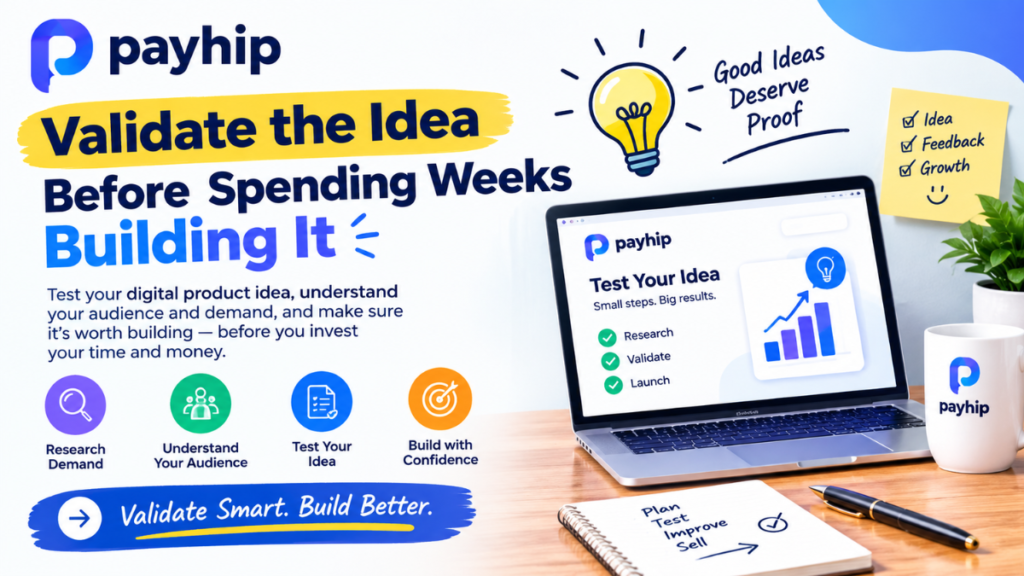
This is one of the most important steps.
Don’t spend two months creating a product that nobody asked for.
Before building the full version, create a simple description of the idea and show it to potential customers.
For example:
“I’m creating a Google Sheets system for freelancers that tracks client projects, invoices, payment deadlines, and monthly income. Would this be useful to you?”
Ask people who actually fit your target audience.
You can also create a simple landing page with:
- Product name
- Problem it solves
- Main features
- Screenshots or a basic mockup
- Expected price
- Email signup or purchase option
The goal isn’t to collect compliments.
“That sounds cool” doesn’t prove much.
A stronger signal is someone asking:
“When can I buy it?”
Even better is someone willing to pay.
A simple validation test
Imagine you want to sell a $15 content calendar template.
Instead of building 100 pages of templates, create five useful examples first.
Show them to 10–20 people who match your target audience.
Ask:
- What would you use this for?
- What’s missing?
- What would you expect it to cost?
- What are you currently using?
- Would you actually pay for this?
Their answers may change your product.
That’s a good thing.
Build the Smallest Useful Version
Once you’ve confirmed that the problem is real, build the first version.
Don’t try to make it perfect.
Imagine you’re creating an expense tracker for freelancers.
The first version might include:
- Income entry
- Expense entry
- Monthly totals
- Category breakdown
- Basic dashboard
You don’t necessarily need:
- 50 color themes
- Ten dashboards
- Complex automation
- A mobile app
- An AI assistant
- A community
- A seven-part bonus package
Those things can come later if customers actually want them.
Tools you can use
Your choice depends on the product.
For design work, Canva and Figma are practical starting points.
For spreadsheets, Google Sheets and Microsoft Excel are familiar to most users.
For writing, Google Docs or Microsoft Word can be enough.
For screen recordings, tools such as Loom can make it easy to explain how a product works.
For more advanced products, you might use GitHub alongside your preferred development environment.
You don’t need to use every tool available. Too many tools can become another form of procrastination.
Make the Product Easy to Use
A digital product can be technically excellent and still frustrate customers.
I’ve seen this happen with templates in particular.
The creator builds something impressive, but the buyer opens it and doesn’t know where to begin.
Your product should answer three questions quickly:
What is this?
How do I use it?
What should I do first?
Include a short setup guide.
For a spreadsheet, for example, you might provide a first page called “Start Here” containing:
- Make your own copy.
- Enter your monthly income.
- Add your regular expenses.
- Select a category for each expense.
- Check the dashboard.
That’s much more useful than giving someone a beautiful spreadsheet with no instructions.
Decide Where You Will Sell It
You have several options.
Your own website
A website gives you more control over branding, pricing, content, and customer relationships.
You can build a simple site with platforms such as WordPress, Shopify, or other website builders.
For a small business, you don’t need 30 pages.
A useful product page may only need:
- A clear headline
- The customer’s problem
- Product screenshots
- What’s included
- Who it’s for
- Price
- Frequently asked questions
- Purchase button
- Refund information
Digital product marketplaces
Platforms such as Gumroad and Etsy can be useful depending on the type of product you’re selling.
Marketplaces can make the initial setup easier, although you still need to understand their fees, rules, search systems, and customer expectations how to start a digital product business.
Don’t assume that uploading a product automatically creates traffic.
A marketplace is a sales channel, not a substitute for marketing.
Set a Price Without Guessing Wildly
Pricing makes many beginners uncomfortable.
They often think:
“Nobody will pay $20 for a spreadsheet.”
But price should be connected to the problem being solved, not simply the number of pages in the product.
A $10 template that saves someone two hours every week can be more useful than a $30 ebook containing information they never use how to start a digital product business.
Start with a reasonable price based on:
- The usefulness of the product
- The amount of work required to create it
- The audience’s budget
- Similar products in the market
- The amount of support you’ll provide
You can test different prices over time.
For example, you might launch a simple template at $12, then later introduce a larger version at $24 with additional features.
Keep your pricing and product descriptions honest. Don’t manufacture fake discounts or make claims about earnings that you can’t support how to start a digital product business.
Create a Product Page That Answers Real Questions
A weak product page usually talks too much about the creator.
A stronger one focuses on the customer’s situation.
Instead of:
“This is my professionally designed productivity template.”
Try:
“Plan your weekly tasks, deadlines, and appointments in one place without building your own system from scratch.”
Then show the product.
Screenshots matter.
If you’re selling a Notion template, show the actual dashboard.
If you’re selling a spreadsheet, show the spreadsheet.
If you’re selling a design pack, show several examples.
People want to know what they’re buying before they pay.
Get Your First Customers Without Pretending to Be a Marketing Expert
Your first customers will probably come from direct effort rather than passive traffic.
Start where your target audience already spends time.
For example:
- A designer could share useful tips on LinkedIn.
- A teacher could demonstrate worksheets on Pinterest or Instagram.
- A developer could publish tutorials on a personal website or GitHub.
- A freelancer could share workflow tips in relevant communities.
- A photographer could post before-and-after examples.
The important part is that your content should be useful even if the reader doesn’t buy anything.
Suppose you sell a freelancer invoice template.
Instead of posting:
“Buy my invoice template!”
You could publish:
“Five details every freelance invoice should include.”
Then demonstrate the process and mention your template naturally at the end.
That gives people a reason to pay attention.
Don’t Ignore Customer Support
A digital product doesn’t mean you have zero work after the sale.
Customers may ask:
- How do I download this?
- Which software do I need?
- Why isn’t the formula working?
- Can I use this commercially?
- Can I edit the design?
- Where is the bonus file?
Create a simple FAQ and installation guide.
If you notice the same question appearing repeatedly, improve the product documentation instead of answering the same question forever how to start a digital product business.
This is one of the easiest ways to make a small digital product business more manageable.
Learn From Refunds and Complaints
A refund isn’t automatically a failure.
Sometimes it reveals a problem in your product page or onboarding.
Imagine several customers purchase your spreadsheet and then request refunds because they expected it to work with Excel, while you clearly built it for Google Sheets how to start a digital product business.
That’s useful information.
You could:
- Make the platform requirement more obvious
- Add screenshots
- Explain compatibility before checkout
- Create an Excel version if demand justifies it
Customer complaints can reveal gaps that you couldn’t see while building the product yourself.
Common Mistakes to Avoid
Building for everyone
“Small businesses” is not a useful target audience by itself.
A restaurant owner and a freelance web designer have completely different problems.
Get specific.
Creating too much too early
A giant product can take months to finish.
Start with the smallest version that solves the main problem.
Copying competitors too closely
Researching competitors is normal.
Copying their wording, designs, branding, or product content isn’t a sustainable strategy.
Use competitors to understand the market, then create something with your own approach.
Spending more time on branding than the product
A logo isn’t going to fix a product nobody needs.
Early on, spend more time talking to customers and improving the actual product.
Expecting instant passive income
Digital products can be delivered automatically, but that doesn’t mean the business requires no work.
You’ll still need to:
- Market the product
- Answer customers
- Fix errors
- Update outdated information
- Improve your sales page
- Test new ideas
The delivery can be automated. The business still needs attention.
A Simple 30-Day Starting Plan
If you want a practical schedule, keep the first month small.
Days 1–5: Choose a specific audience and identify several recurring problems.
Days 6–10: Talk to potential customers and research existing solutions.
Days 11–18: Build the first useful version of your product.
Days 19–21: Give it to a few testers and fix confusing parts.
Days 22–24: Create your product page, screenshots, instructions, and FAQ.
Days 25–27: Set up payments and digital delivery.
Days 28–30: Publish useful content and start showing the product to your target audience.
This isn’t a guarantee that you’ll make sales in 30 days. The purpose is to avoid spending months planning without ever putting something in front of customers how to start a digital product business.
What Happens After the First Sale?
The first sale is useful, but the information behind it can be even more valuable.
Pay attention to:
- Where the customer discovered you
- What convinced them to buy
- Which product feature they mention
- What questions they ask
- Whether they finish using the product
- Why people request refunds
- What customers ask you to add
Suppose your first 20 customers keep asking for a feature that you didn’t include.
That’s a signal worth investigating.
On the other hand, if nobody uses a feature you spent three weeks building, you may have found something to remove.
A digital product business gets better when you stop guessing and start paying attention to actual customer behavior.
The Part Most Beginners Underestimate
Creating the file is only one part of the job.
The real business is the combination of problem selection, product quality, distribution, customer support, and continuous improvement how to start a digital product business.
You don’t need an enormous product catalog.
One genuinely useful product can teach you more than ten unfinished ideas sitting on your hard drive.
If I were starting from scratch, I’d choose one narrow problem, talk to real potential customers, build a small solution, put it in front of people quickly, and improve it based on what actually happens how to start a digital product business.
That approach keeps the risk manageable and, more importantly, turns the idea into a real business instead of another project that never gets launched how to start a digital product business.