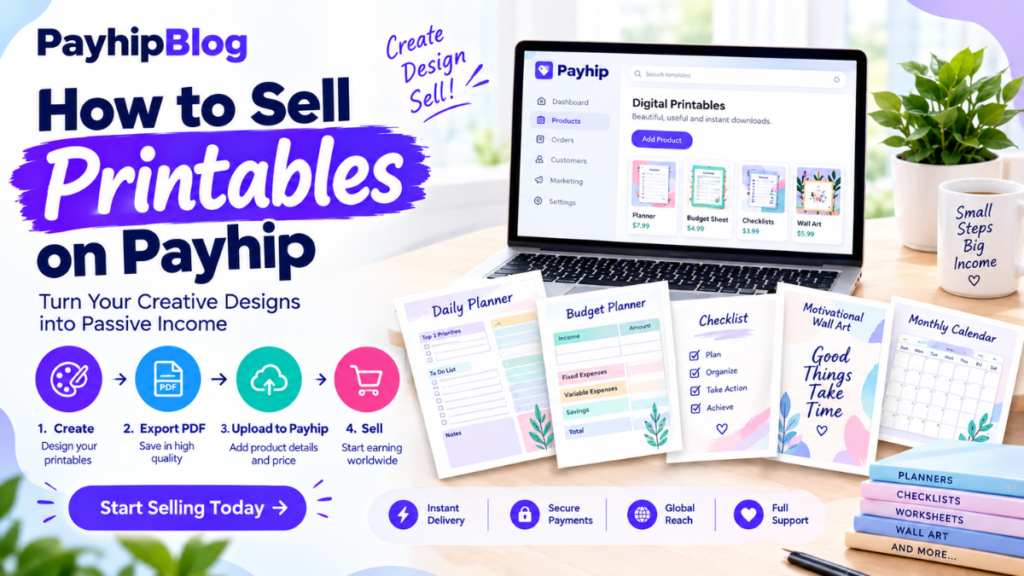
how to sell printables on Payhip Selling printables online sounds simple: create a PDF, upload it somewhere, and wait for people to buy it how to sell printables on Payhip.
In practice, the hard part isn’t uploading the file. It is choosing something people actually need, making the printable easy to use, presenting it properly, and getting your first visitors to the product page how to sell printables on Payhip.
I like Payhip for this type of business because it lets you set up a simple digital storefront without building a full ecommerce website. You can upload a digital product, add a description and price, connect a payment method, and share the product link how to sell printables on Payhip.
If you’re starting from scratch, you can also do most of the work with tools you may already know, such as Canva, Google Docs, Microsoft Excel, or Adobe Acrobat how to sell printables on Payhip.
This guide walks through the process from creating your first printable to making your first sale, including some of the mistakes that are easy to overlook how to sell printables on Payhip.
What Exactly Is a Printable?
A printable is a digital file that customers purchase and download for their own use.
The customer might print it at home, at work, or through a local printing service. Some printables can also be used digitally on a tablet or computer how to sell printables on Payhip.
Common examples include:
- Weekly and monthly planners
- Budget worksheets
- Meal planners
- Cleaning checklists
- Wedding planning templates
- Kids’ activity sheets
- Habit trackers
- Reading logs
- Study planners
- Business worksheets
- Invoice templates
- Printable calendars
- Party games
- Classroom resources
For example, imagine you create a simple weekly meal planner. It could contain sections for seven days, a grocery list, and a small notes area how to sell printables on Payhip.
You don’t need 50 pages to make it useful. A clean, well-designed three-page product can be more useful than a huge bundle that feels confusing how to sell printables on Payhip.
That’s one lesson worth remembering: a printable solves a small problem.
Why Use Payhip to Sell Printables?
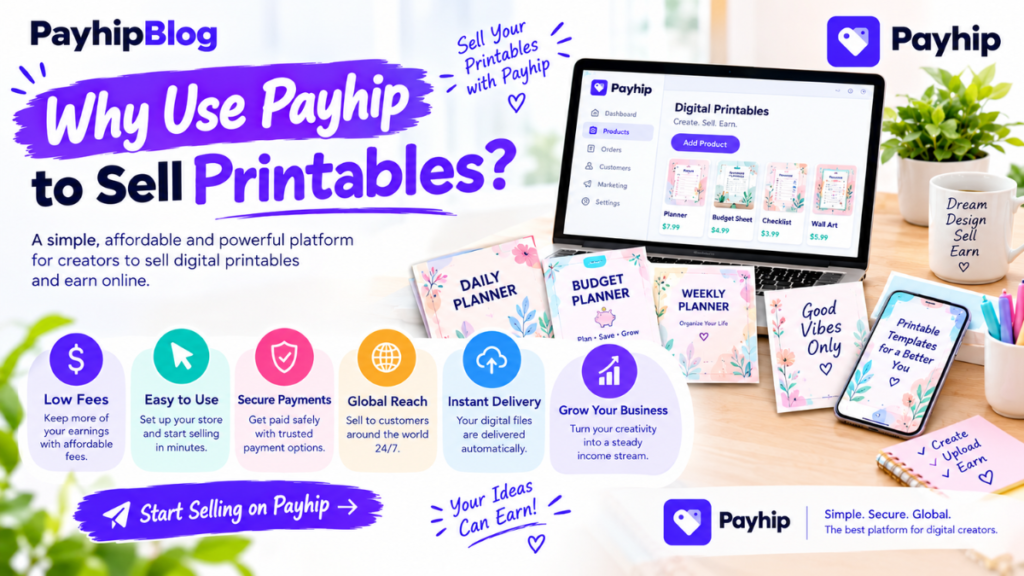
Payhip is a platform for selling digital products and other types of products online.
For a beginner, one of its useful features is that you don’t have to create an entire ecommerce website before testing an idea.
You can create a product page, upload your printable, set the price, and share the resulting store or product link.
The exact payment options and fees available to you can depend on your country and the payment processors you connect, so check Payhip’s current pricing and payment information before making financial decisions how to sell printables on Payhip.
For someone testing a first printable, this can be much less work than setting up a complete online store.
Step 1: Choose a Printable People Actually Need
Don’t start with Canva.
Start with the problem.
This is where I see beginners lose a lot of time. They open Canva, browse templates, make something that looks nice, and only afterward wonder who would buy it how to sell printables on Payhip.
Instead, ask:
What would make someone’s day easier?
Suppose you enjoy organizing your finances. You could create:
Monthly Budget Planner
Income + Bills + Savings + Spending Tracker
That’s more specific than simply calling it a “Finance Printable.”
Or imagine you’re targeting university students. Instead of a generic planner, you might create:
Exam Revision Planner for College Students
It could include:
- Subject
- Exam date
- Topics to revise
- Study sessions
- Practice test score
- Questions to review
The narrower idea is often easier to explain and market.
Do Some Basic Research
Before designing anything, search places where people discuss problems.
Look at:
- Google search suggestions
- Reddit discussions
- Facebook groups where appropriate
- Etsy search results
- YouTube comments
- Your own questions and problems
Don’t copy another seller’s product.
You’re looking for recurring problems and language people use to describe them.
For example, if you notice people repeatedly asking how to organize household cleaning, that could inspire a cleaning schedule printable how to sell printables on Payhip.
Step 2: Create Your Printable
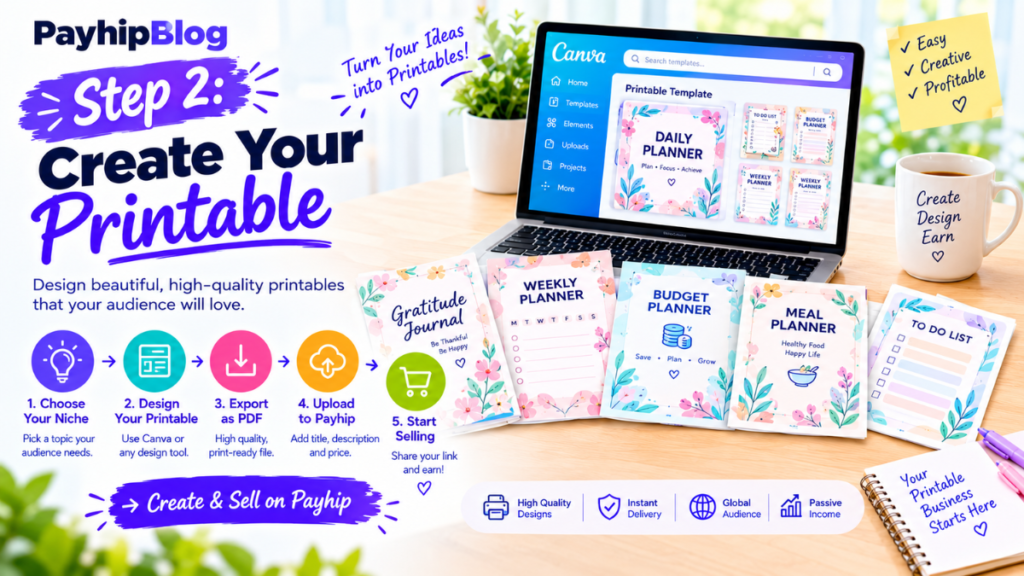
You don’t need expensive software.
Canva
Canva is one of the easiest options for beginners. You can create a document, add text boxes, tables, shapes, lines, and other design elements, then export the finished file as a PDF how to sell printables on Payhip.
Keep the design practical.
A common beginner mistake is making the page look attractive but leaving too little room to write.
For a planner, writing space is more important than decorative elements.
Google Docs
Google Docs works surprisingly well for simple worksheets, checklists, guides, and text-heavy printables.
You can create headings, tables, checkboxes, and simple layouts, then download the document as a PDF.
Microsoft Excel or Google Sheets
These are useful when your printable involves calculations.
For example, a budget worksheet might have:
| Category | Planned | Actual | Difference |
| Rent | $800 | $800 | $0 |
| Groceries | $300 | $340 | -$40 |
| Transport | $100 | $85 | $15 |
You can create the spreadsheet first and then provide a printable PDF version if that’s what your customer needs.
Step 3: Make the File Easy to Print
This part is easy to ignore until someone complains.
Before uploading your printable, print it yourself.
You don’t necessarily need a professional printer. A basic home inkjet printer is enough for testing.
Check:
- Are the margins correct?
- Is any text cut off?
- Are the fonts readable?
- Is there enough writing space?
- Does the page look good in black and white?
- Are the lines dark enough to print clearly?
- Does the PDF open correctly?
Also consider different paper sizes.
A customer in the United States may expect US Letter, while customers in many other countries commonly use A4.
If your target audience is international, providing both A4 and US Letter versions can make the product more convenient.
For example, your download folder could contain:
Weekly-Planner/
├── A4-Version.pdf
├── US-Letter-Version.pdf
└── Read-Me.pdf
That small detail can make a digital product feel much more professional.
Step 4: Add Instructions
Don’t assume the customer knows exactly what to do.
A short “Read Me” PDF can explain:
- What files are included
- How to download them
- Recommended paper size
- Whether they can print at home
- Whether the file is intended for personal use
- How to contact you if there’s a problem
If your printable has several versions, explain the difference.
For example:
Use the A4 file if you normally print on A4 paper. Use the US Letter file if your printer uses 8.5 × 11 inch paper.
It takes only a few minutes and can prevent unnecessary customer questions.
Step 5: Create Your Payhip Store
Once the printable is ready, create your Payhip account and follow the setup process.
You’ll need to configure your store and connect the payment method or methods available to you.
Then create a digital product.
Add:
- Product name
- Product description
- Price
- Product image
- Downloadable files
- Relevant settings
Don’t rush through the product description.
Your customer should understand what they’re buying without having to guess.
A Weak Product Description
Cute printable planner for organizing your week.
That’s not enough information.
A More Useful Description
A simple weekly planner designed for busy students and professionals. The printable includes a weekly schedule, priority list, habit tracker, and notes section. You will receive A4 and US Letter PDF files that you can print at home how to sell printables on Payhip.
The second version tells the buyer what the product does and what they receive.
Step 6: Price Your Printable Sensibly
Pricing digital products can feel awkward when the product is “just a PDF.”
But you’re not only charging for the file.
You’re charging for the time spent researching the problem, designing the pages, testing them, fixing mistakes, and packaging the product how to sell printables on Payhip.
There is no single correct price.
A one-page checklist and a 60-page collection shouldn’t necessarily cost the same.
As a simple starting point, you might test:
- Single-page printable: around 1–3
- Small collection: around 3–7
- Larger themed bundle: around 7–20+
These are only examples, not rules. Your niche, quality, uniqueness, audience, and competition all affect what makes sense.
Don’t automatically make your product extremely cheap just because you’re new.
At the same time, don’t put a high price on a basic worksheet simply because someone else sells expensive bundles.
Step 7: Create Good Product Images
Your product page needs visuals.
Don’t just upload a screenshot of the PDF sitting on your desktop.
Create a few clear preview images showing what the customer receives.
For a meal planner, you might show:
Image 1: The complete planner on a desk
Image 2: Close-up of the weekly planning section
Image 3: Grocery list page
Image 4: A simple graphic explaining what is included
You can create these mockups in Canva or similar design software.
The purpose isn’t to make the product look expensive.
The purpose is to remove uncertainty.
A buyer should be able to look at the preview and think, “Yes, that’s exactly what I need.”
Step 8: Test the Entire Buying Process
Before promoting your product, pretend you’re the customer.
Open your store on your phone.
Then check it on a laptop or desktop.
Look at the product page and ask:
- Is the title clear?
- Can I understand the product in 10 seconds?
- Are the preview images readable?
- Is the price obvious?
- Do I know what files I’ll receive?
- Are the instructions clear?
- Can I find the download after purchasing?
If possible, make a test purchase using the platform’s available testing or normal purchase workflow as appropriate.
You want to discover problems before a real customer does.
A broken download link or confusing file name can turn an otherwise good product into a frustrating experience.
Step 9: Get People to Your Payhip Store
Uploading a product doesn’t automatically bring customers.
This is probably the biggest expectation beginners need to adjust.
Your Payhip store is the checkout and delivery system. You still need a way to attract relevant visitors.
Pinterest can work well for visual products.
Suppose you’ve created a printable weekly meal planner.
Instead of creating one generic pin, create several useful-looking graphics around the same product:
- Weekly Meal Planning Ideas
- Simple Grocery List Template
- How to Plan Meals for a Busy Week
- Printable Meal Planner
- Easy Weekly Food Planning
Each piece of content can point interested people toward your product.
TikTok or Instagram
Short videos can demonstrate the printable.
For example, record your screen while filling out the planner on a tablet.
Or film yourself printing it and putting it into a binder.
You don’t need a complicated video.
A simple demonstration can answer questions that a product description can’t.
Your Own Website or Blog
If you enjoy writing, a blog can become a long-term traffic source.
For example, if you sell a budget planner, write helpful articles about:
- How to create a monthly budget
- How to track irregular expenses
- Common budgeting mistakes
- How to organize bills
The articles should be genuinely useful rather than existing only to advertise your printable.
You can naturally mention the related product where it makes sense.
A Realistic Example
Imagine you create a “Student Study Planner.”
You spend a weekend making:
- Semester overview
- Monthly study calendar
- Weekly schedule
- Assignment tracker
- Exam revision planner
- Grade tracker
You export A4 and US Letter PDFs and create five product preview images.
You list the product on Payhip for $6.
Then you post a short video showing how you use the planner to organize an upcoming exam week.
You also publish a helpful article explaining how to build a weekly study schedule.
Nobody buys immediately.
That’s normal.
Instead of assuming the product has failed, look at the whole process.
Maybe people are viewing the product but not purchasing. Your description or preview images might need improvement.
Maybe nobody is visiting the page. The problem could be traffic rather than the product itself.
Maybe people are asking whether there’s a digital version. That is useful feedback. You could eventually create a tablet-friendly version if it makes sense.
This is much more useful than changing the price every few days without knowing what’s wrong.
Common Mistakes I Would Avoid
Making Too Many Products Too Quickly
It’s tempting to upload 30 printables in your first month.
But if you don’t know what your audience wants, you’ll simply create 30 guesses.
Start with a small number and learn from actual visitors and customers.
Using Too Many Fonts
A printable needs to be readable.
Using six different fonts may look creative while you’re designing it, but it often makes the finished page harder to use.
Two or three complementary fonts are usually plenty.
Forgetting Mobile Buyers
Even though customers may eventually print your product, many will discover it on their phones.
Check your Payhip product page from a smartphone.
Make sure the title and product images still make sense on a small screen.
Ignoring File Organization
Don’t upload files named:
final.pdf
final2.pdf
finalNEW.pdf
final-newest.pdf
Use meaningful names:
Student-Study-Planner-A4.pdf
Student-Study-Planner-US-Letter.pdf
Instructions.pdf
It sounds minor, but professional file organization makes a difference.
Copying Popular Products
Seeing another seller make money from a particular type of printable can be useful research.
Copying their exact design, wording, illustrations, branding, or other protected material is a different matter.
Create your own product.
Use competitors to understand the market, not to reproduce someone else’s work.
What About Canva’s Templates and Graphics?
Pay attention to the license terms for any design assets, fonts, photos, illustrations, or templates you use.
Don’t assume that because an element is available inside a design platform, you can automatically redistribute it as a standalone digital asset.
The safest habit is to understand the licensing terms for the specific content you’re using and make sure your final product complies with them.
This is particularly important if you’re selling editable templates or products where the buyer might extract individual graphics.
How to Improve a Printable After Your First Sales
Your first version doesn’t have to be perfect.
Suppose customers keep asking:
“Does this work with A4?”
That’s a sign to add an A4 version.
If customers ask:
“Can I use this on my iPad?”
You might consider creating a separate digital-friendly version if the product concept supports it.
If people say:
“The text is too small.”
Fix it.
Customer questions are useful product research.
Keep a simple note on your phone or computer containing common questions and requests.
After a few months, you may have a much better idea of what your customers actually want than you did when you created your first product.
Can You Make Money Selling Printables on Payhip?
Yes, it is possible to sell printables through Payhip, but there is no guaranteed income level.
Your results depend on factors such as product quality, demand, pricing, traffic, competition, marketing, customer trust, and how consistently you improve your store.
Don’t build your plan around screenshots of people claiming they made thousands of dollars overnight.
A healthier approach is to treat your first product as an experiment.
Make something useful.
Get it in front of the right people.
Watch what happens.
Improve the product or presentation.
Then create the next product based on what you’ve learned.
That’s a much more realistic way to approach a small digital-product business.
A Simple First-Product Checklist
Before publishing, I would check these items:
- The printable solves a specific problem
- The design is easy to read
- The PDF has been tested
- A4 and/or US Letter versions are included where appropriate
- File names are clear
- A short instruction file is included
- Product images show the actual contents
- The Payhip description explains exactly what buyers receive
- The price makes sense for the amount of value provided
- Payment settings are configured
- The product page works on mobile
- You have at least one plan for bringing visitors to the store
The best place to start isn’t with a huge collection or a complicated brand.
Start with one useful printable.
Make it, print it, test it, upload it, and show it to people who actually have the problem it solves how to sell printables on Payhip.
Once you understand what customers respond to, creating your second and third products becomes much easier. You aren’t guessing as much because you’re building from real feedback rather than designing in a vacuum how to sell printables on Payhip.
And that’s where selling printables on Payhip becomes more interesting: not when you have hundreds of files sitting in a store, but when you start understanding which small problems people are genuinely willing to pay to solve how to sell printables on Payhip.