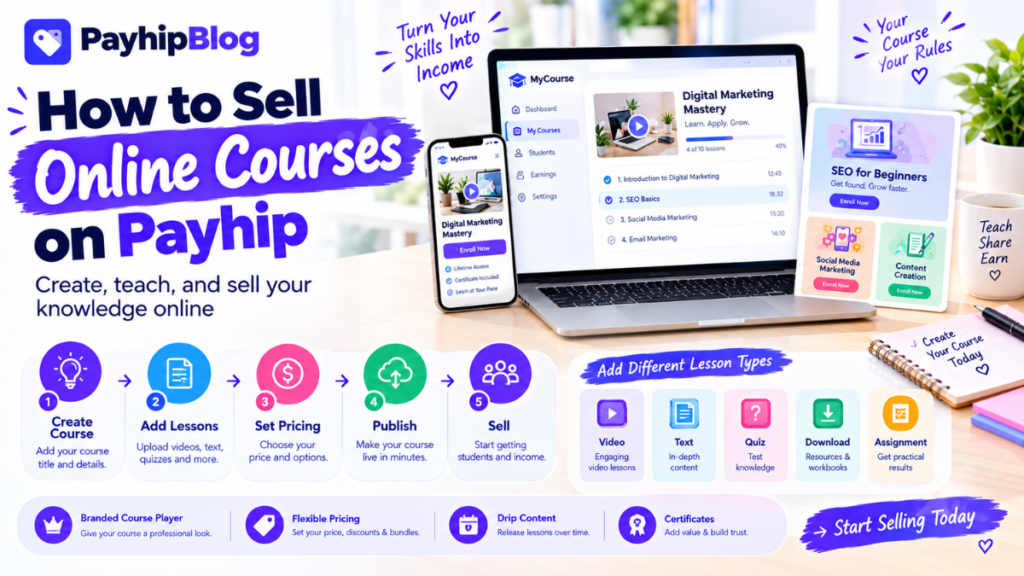
Selling an online course sounds simple until you actually try to do it.
how to sell online courses on Payhip You need somewhere to host the course, a checkout page, a way to collect payments, a place to deliver the lessons, and some method of bringing students to your sales page. If you are not careful, you can end up paying for several different tools before you make your first sale.
That is one reason Payhip is worth looking at.
Payhip lets creators sell digital products, including online courses, from a storefront without building a complete ecommerce website from scratch. You can upload your course content, set a price, connect supported payment methods, and share your product page with potential students how to sell online courses on Payhip.
I would not treat Payhip as a magic “upload a course and get sales” platform, though. The technical setup is only one part of the job. The harder part is creating a course people actually want and giving them a clear reason to buy it how to sell online courses on Payhip.
This guide walks through the process from creating the course to getting your first customers.
What Is Payhip?
Payhip is a platform for selling digital products online. Depending on the features available to your account and location, you can use it for things such as ebooks, templates, memberships, digital downloads, and online courses how to sell online courses on Payhip.
The basic idea is straightforward:
You create the product → Payhip provides the storefront and checkout → the customer pays → the customer gets access to the product.
For a course creator, this can be much easier than building a custom website with WordPress, installing an LMS plugin, configuring payment gateways, and troubleshooting everything yourself.
For example, imagine you are a photographer who wants to sell a beginner course called “Manual Camera Settings for Beginners.”
Instead of building an entire photography website, you could create the course, upload your lessons to Payhip, add a course description and price, and then share the course link on Instagram, YouTube, Facebook, or your email list how to sell online courses on Payhip.
Before You Create Your Payhip Course, Decide What You Are Selling

One mistake I see often is starting with the platform instead of the student.
People open Payhip, look at the course settings, and then start uploading random videos.
It is better to work backward.
Ask:
- Who is this course for?
- What problem does it solve?
- What should students be able to do after finishing it?
- How long should the course take?
- What will students receive besides videos?
- Why would someone pay for this instead of watching free YouTube videos?
That last question matters.
Suppose you want to create a course about Excel. “Learn Excel” is too broad. There are thousands of free tutorials covering it.
A more specific course could be:
“Excel for Small Business Owners: Build Your First Sales Dashboard.”
Now the buyer understands the outcome.
You could include lessons on:
- Setting up the workbook
- Cleaning sales data
- Creating formulas
- Building charts
- Creating a simple dashboard
- Exporting monthly reports
You could also provide a downloadable practice spreadsheet.
That is much easier to market than a vague course called “Complete Excel Course.”
Step 1: Create Your Payhip Account
Start by creating an account on Payhip.
After signing in, spend a little time looking around the dashboard before uploading anything. Find the areas for products, store settings, payments, and customer information how to sell online courses on Payhip.
The exact interface and available features can change over time, so follow the labels shown in your own Payhip dashboard rather than relying on an old screenshot from a blog post how to sell online courses on Payhip.
You should also check which payment processors are available in your country.
This is particularly important if you live outside the US or UK.
A course can have a beautiful sales page, but if customers cannot complete payment using a method available to them, you have a problem how to sell online courses on Payhip.
Step 2: Connect Your Payment Method
Before spending hours recording your course, check your payment setup.
Payhip may work with payment providers such as PayPal or Stripe, depending on your location and account eligibility. Availability and requirements can change, so check the payment options displayed inside your account how to sell online courses on Payhip.
You will generally need to provide the required information to the payment processor, which may include identity, business, or bank information how to sell online courses on Payhip.
Do not wait until after launching your course to discover that your preferred payment method is unavailable.
A practical test
Once your payment setup is ready, go through your own storefront as if you were a customer.
Check:
- Does the product page load properly?
- Is the price displayed correctly?
- Does the checkout work?
- Are the payment options visible?
- Does the customer receive access after purchasing?
- Can the course be opened on a phone?
That last test is easy to forget.
Step 3: Plan the Course Before Recording It
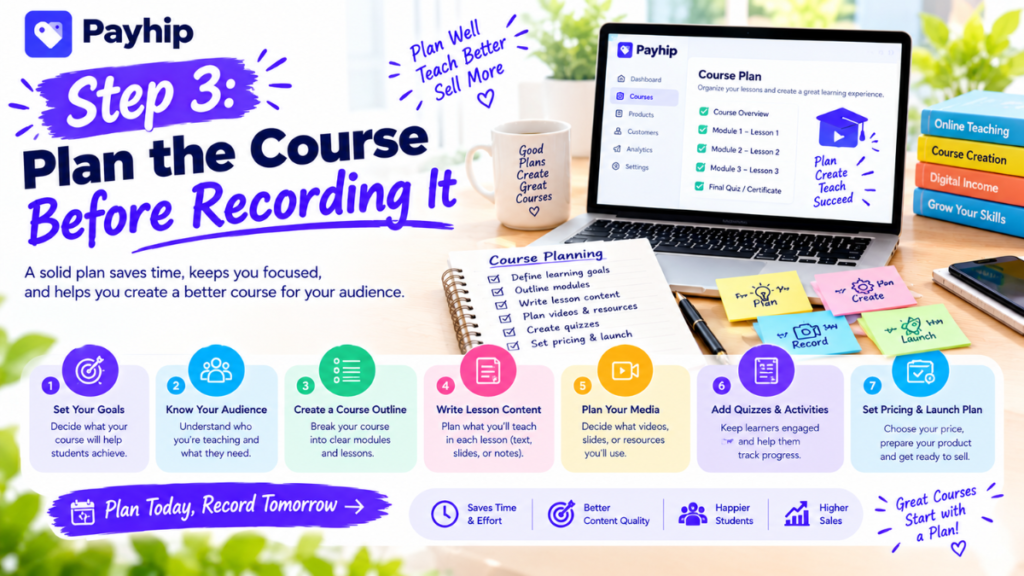
You do not need a Hollywood production setup.
You do need a useful structure.
For example, let’s say you are creating a course that teaches people how to start a freelance graphic design business.
A simple course could look like this:
Module 1 — Getting Started
- Choosing your service
- Understanding your target customer
- Setting realistic beginner prices
Module 2 — Building Your Portfolio
- Creating sample projects
- Using Canva or Adobe tools
- Preparing portfolio images
Module 3 — Finding Clients
- Writing a simple proposal
- Finding suitable freelance opportunities
- Communicating with potential customers
Module 4 — Delivering Projects
- Managing revisions
- Sending final files
- Asking for testimonials
Module 5 — Building a Repeatable Process
- Organizing projects
- Creating templates
- Following up with previous clients
This is much easier to record than sitting in front of a microphone and trying to talk for six hours.
Keep individual lessons focused.
A 10-minute lesson that solves one clear problem is often more useful than a 60-minute video where five different subjects are mixed together.
Step 4: Record Your Lessons
You can create a perfectly usable course with equipment you may already own.
For screen-recorded lessons, a laptop or desktop computer and a decent microphone are usually enough.
Tools such as OBS Studio can be useful for screen recording. For editing, you could use applications such as CapCut, DaVinci Resolve, or another editor you are comfortable with how to sell online courses on Payhip.
If you are recording yourself, a modern smartphone can also produce surprisingly good video.
The biggest improvement usually comes from audio.
A 30–100 microphone used correctly can make a bigger difference than buying an expensive camera while recording in a noisy room how to sell online courses on Payhip.
A simple recording setup
You could use:
- A Windows laptop or MacBook
- A USB microphone
- Your phone as a second camera
- OBS Studio for screen recording
- CapCut or another editor for basic editing
- Google Docs for your lesson scripts
- Canva for worksheets and presentation graphics
You do not need to use all of these.
For a software course, for example, I would prioritize a clean screen recording and clear narration over fancy camera shots.
Step 5: Create Supporting Materials
This is an easy way to make a course more useful.
If the student is learning something practical, give them something they can actually use.
For example:
Photography course:
- Camera settings cheat sheet
- Shooting checklist
- Practice assignments
Excel course:
- Practice spreadsheet
- Formula cheat sheet
- Dashboard template
Freelancing course:
- Proposal template
- Client questionnaire
- Project checklist
Language course:
- Vocabulary worksheet
- Practice exercises
- Revision schedule
These resources can also make your sales page more convincing because you can clearly explain what the customer receives.
Step 6: Add the Course to Payhip
Once your content is ready, go to the product section of your Payhip dashboard and create a new product.
Select the option for a course if it is available in your account.
You will need to enter information such as:
- Course name
- Description
- Price
- Cover image
- Course lessons
- Supporting files
- Other settings offered by Payhip
Take your time with the product description.
Don’t write:
“This amazing course will completely transform your life and make you successful.”
That kind of copy sounds like an advertisement and tells the customer almost nothing.
Instead, explain exactly what they will learn.
For example:
“This beginner-friendly Excel course shows small business owners how to turn a basic sales spreadsheet into a simple monthly dashboard. You will learn how to clean your data, use common formulas, create charts, and build a dashboard you can reuse.”
That is specific.
Step 7: Price Your Course Sensibly
There is no universal “correct” price for an online course.
A short beginner course with five lessons is different from a detailed professional training program with 40 lessons and downloadable resources how to sell online courses on Payhip.
Think about the value of the result, the depth of the material, your audience, and what alternatives they have.
For example, a small course might be priced around 15–30, while a more detailed course could be priced considerably higher.
Do not assume that a higher price automatically makes a course look more professional.
At the same time, don’t price a substantial course at $2 simply because you are worried nobody will buy it.
A useful approach for a new creator is to launch with a reasonable price, collect feedback from early students, and improve the course based on what people actually struggle with how to sell online courses on Payhip.
You can also experiment with discounts or limited promotional offers without permanently reducing the perceived value of the course how to sell online courses on Payhip.
Step 8: Write a Sales Page That Answers Real Questions
Your sales page should help the buyer decide whether the course is appropriate for them.
A useful structure is:
What will I learn?
List the specific skills or outcomes.
Who is this course for?
Explain the student’s starting level.
What is included?
Mention videos, worksheets, templates, assignments, or other resources.
How long is the course?
Give an approximate learning time if possible.
Do I need any previous experience?
Be honest.
What equipment or software do I need?
This is particularly important for technical courses.
For example, if your course teaches Adobe Photoshop, don’t make someone discover after buying that they need a paid version of the software how to sell online courses on Payhip.
Step 9: Test Everything Before Launching
This step has saved me from some embarrassing mistakes.
Don’t assume your product works simply because you uploaded the files.
Open the store page on your phone.
Then open it on your computer.
Click every important button.
Play the first lesson.
Download the included worksheet.
Check your emails.
Go through checkout if your setup allows you to test it safely.
Look for simple problems such as:
- Broken links
- Incorrect lesson names
- Missing downloads
- Typographical errors
- Videos with poor audio
- Incorrect prices
- Confusing instructions
Ask a friend to test the course too.
A fresh pair of eyes often notices things the creator has stopped seeing.
Step 10: Start Getting Traffic
Payhip gives you a place to sell the course.
It does not automatically give you an audience.
This distinction is important.
You can have an excellent course and still make very few sales if nobody sees it.
Choose one or two marketing channels rather than trying everything simultaneously.
YouTube
You can publish useful free tutorials related to your course.
For an Excel course, you might create videos such as:
- “5 Excel formulas every small business owner should know”
- “How to create a simple sales chart in Excel”
- “How to clean messy Excel data”
At the end, naturally mention that you have a more detailed course for people who want guided lessons and practice materials.
Instagram or TikTok
Short educational clips can work well for visually demonstrable topics.
For example, a Photoshop instructor could show a quick before-and-after editing technique.
The free content should be genuinely useful rather than being a 30-second advertisement.
If you already have an audience, email can be one of the simplest ways to announce your course.
Instead of sending only “My new course is available,” explain why you created it and what problem it solves.
Communities
Relevant Facebook groups, Reddit communities, Discord servers, forums, and professional communities can also help, but avoid dropping promotional links everywhere how to sell online courses on Payhip.
Participate normally.
If a community allows relevant resources and your course genuinely answers the question being discussed, share it according to that community’s rules how to sell online courses on Payhip.
A Realistic Example
Imagine you teach WordPress and create a course called:
“Build a Small Business Website Without Hiring a Developer.”
You record 18 lessons using your laptop and microphone.
The course includes:
- 18 short videos
- A website planning worksheet
- A homepage checklist
- A plugin selection checklist
- A basic SEO checklist
You price it at $39.
Instead of immediately buying advertisements, you publish several free YouTube tutorials covering related problems.
Someone watches a tutorial about creating a WordPress contact page. They find the course link in the description, visit your Payhip product page, read what is included, and purchase how to sell online courses on Payhip.
That customer isn’t buying “18 videos.”
They are buying a guided path to a specific result.
That difference matters when you write your marketing copy.
Common Payhip Course-Selling Mistakes
Making the course too broad
“Learn Digital Marketing” is difficult to position.
“Instagram Content Planning for Local Restaurants” is much more specific.
Recording everything before validating the idea
You can spend weeks producing a course nobody wants.
Before recording 30 lessons, talk to potential students. Ask what they struggle with. Look at questions people repeatedly ask in relevant communities how to sell online courses on Payhip.
Overproducing the videos
Fancy intros, animations, and cinematic effects are not what most students need.
Clear explanations are more important.
Ignoring mobile users
Open your course on your phone.
If the text is tiny, downloads are confusing, or videos are difficult to watch, fix the experience.
Forgetting updates
Software changes.
Websites change.
Rules change.
If you teach a tool such as WordPress, Photoshop, Excel, or another regularly updated product, revisit your course periodically.
You don’t necessarily need to re-record everything. Sometimes a revised worksheet, updated lesson, or short announcement can handle a change how to sell online courses on Payhip.
Relying entirely on Payhip for marketing
Payhip can handle important parts of selling and delivering your digital product, but you still need a way to reach potential customers how to sell online courses on Payhip.
Your audience can come from YouTube, search traffic, social media, an email list, partnerships, or other legitimate channels.
How to Improve Sales Without Becoming Pushy
If visitors reach your course page but don’t buy, don’t immediately assume you need a bigger discount.
Look at the page from the buyer’s perspective.
Can they quickly answer:
What will I learn?
Is this suitable for me?
What exactly do I receive?
How much time will it take?
What does it cost?
Why should I take this course instead of using free resources?
If those questions aren’t answered, improve the page before changing the price.
You can also add a short preview lesson so potential students can hear your teaching style.
That can reduce uncertainty, especially if you are a new creator without many testimonials.
What I Would Do If I Were Starting From Zero
I wouldn’t spend months trying to build a giant course.
I’d start with one narrow problem.
I’d create a small but genuinely useful course, perhaps 60–120 minutes of focused material, plus practical resources.
I’d test the payment process.
I’d ask a few people from the target audience to review the course.
Then I’d publish useful free content around the same subject.
If people repeatedly ask the same questions, I’d use those questions to improve the paid course.
The first version doesn’t need to be perfect.
It needs to solve the problem it promises to solve.
Once you have real students, their questions become useful information. If several students struggle with the same lesson, that is a signal to improve that part of the course how to sell online courses on Payhip.
That feedback loop is far more useful than guessing what customers want from behind a computer screen.
Final Thoughts
Payhip can make the technical side of selling an online course much simpler because you don’t have to build an entire ecommerce system yourself how to sell online courses on Payhip.
But the platform is only the delivery mechanism.
Your real product is the learning experience.
A focused topic, clear lessons, useful downloadable resources, reliable payment setup, a straightforward sales page, and consistent promotion will matter much more than having flashy course graphics.
Start small enough that you can finish the course, test it with real people, and improve it based on actual feedback. Once students are getting value from the first version, expanding the course becomes much easier—and you have something real to build on.